
FX Providers in the UK and EU: How to Prevent Fraud and Keep Card Processing Reliable
An FX provider taking 800 card payments a month at an average of €500 does not need a fraud wave to get into trouble. Twelve chargebacks can be enough to make a processor look twice, and in a business where money leaves the door within hours, each one can mean a loss you never recover. This guide is for currency exchange and FX payment providers serving customers in the UK, the EU and the EEA, and it covers what to put in place to prevent fraud and keep card processing stable.
We are talking about providers that exchange currency or move money across borders for customers, not leveraged trading platforms. If you run a forex brokerage, our earlier post on going offshore as a forex broker covers that side of the industry.
Why do processors treat FX providers as high risk?
Because FX providers move value that can be converted and sent onward quickly, which makes them attractive to fraudsters and money launderers, acquirers underwrite them far more carefully than ordinary retailers. The risk is structural rather than a judgement on your business.
Three features drive it. Tickets are often large. Outbound payments are usually final once sent, while a card payment that funded them can be disputed weeks later. And FX is a regulated activity, so a processor is also taking a view on your compliance, not only your fraud rate. How a given processor treats you depends on your licence, your history and its own appetite, so expect differences from one acquirer to the next.
Which licences and registrations does an FX provider need in the UK and EU/EEA?
It depends on what you actually do: exchanging cash, executing payments, or holding customer money between receiving and paying out. The UK and each EU/EEA country have their own authorisation and registration routes, so confirm yours before you apply for a merchant account.
In the UK, the FCA supervises payment institutions and e-money institutions under the Money Laundering Regulations, as set out on the FCA’s money laundering regulations page. Some currency-exchange-only businesses may sit under a different supervisor, so check which one applies to your activity. In the EU/EEA, authorisation is granted by a national regulator, and a UK licence does not automatically carry across; take legal advice on how you serve customers in each country.
Whatever your structure, expect an underwriter to ask for evidence of your authorisation or registration early. An unclear regulatory position is one of the quickest ways for an application to stall.
What does safeguarding have to do with payment processing?
If you hold customer money between receiving and paying out, your processor will want to see that it is protected. Strong safeguarding arrangements signal a well-run firm and make underwriting easier.
In the UK, the FCA is tightening the rules for payment and e-money firms. Its supplementary safeguarding regime, which strengthens record keeping, reporting and monitoring, came into force on 7 May 2026 for authorised payment institutions and e-money institutions, with a further end-state regime depending on legislative change. The details are in the FCA’s policy statement PS25/12. In the EU/EEA, safeguarding duties come from national rules implementing the payment services framework. Be ready to explain where customer funds sit, how they are reconciled and who can see the records.
Which fraud controls matter most for an FX provider?
The most effective approach is layered controls at four points: onboarding, the incoming payment, the outgoing payment, and ongoing monitoring. No single check stops everything, and the outgoing payment is where most FX providers are weakest.
- Onboarding: verify identity, screen against sanctions lists, and understand the source of funds for larger customers. These checks support your own anti-money-laundering obligations as well as fraud prevention.
- Incoming card payment: use 3-D Secure where it applies, together with CVV and address checks, and device and IP signals. Strong customer authentication rules under PSD2 apply to many online card payments in the EEA, subject to exemptions, so confirm the current position with your acquirer. The EBA publishes the technical standards on strong customer authentication.
- Outgoing payment: this is the control many providers skip. A card payment can be disputed long after the money has gone, so hold first-time payments to new beneficiaries for review above a threshold you set, and flag a beneficiary that suddenly receives money from many unrelated customers.
- Monitoring: watch velocity by card, device, customer and beneficiary, and look for bursts of small payments that together exceed your review limits.
- Dispute evidence: keep a ready pack for each transaction, including ID check results, IP and device records, authentication outcome and proof the payout was made to the verified customer.
Our fraud reduction page explains how we approach this for high-risk merchants more broadly.
How much can fraud controls change your processing costs?
As an illustration, cutting chargebacks from 12 to 4 a month on 800 payments cuts direct losses by about two-thirds, and may let a processor halve the reserve it holds back. The numbers below are illustrative only; your fees, ticket size and reserve terms will differ.
| Illustrative monthly figures | Weak controls | Layered controls |
|---|---|---|
| Card payments (average €500) | 800 | 800 |
| Monthly card volume | €400,000 | €400,000 |
| Chargebacks per month | 12 (1.5%) | 4 (0.5%) |
| Value lost to chargebacks | €6,000 | €2,000 |
| Chargeback fees (assume €20 each) | €240 | €80 |
| Total monthly chargeback cost | €6,240 | €2,080 |
| Assumed rolling reserve rate | 10% | 5% |
| Reserve withheld each month | €40,000 | €20,000 |
| Cash held at a 6-month plateau | €240,000 | €120,000 |
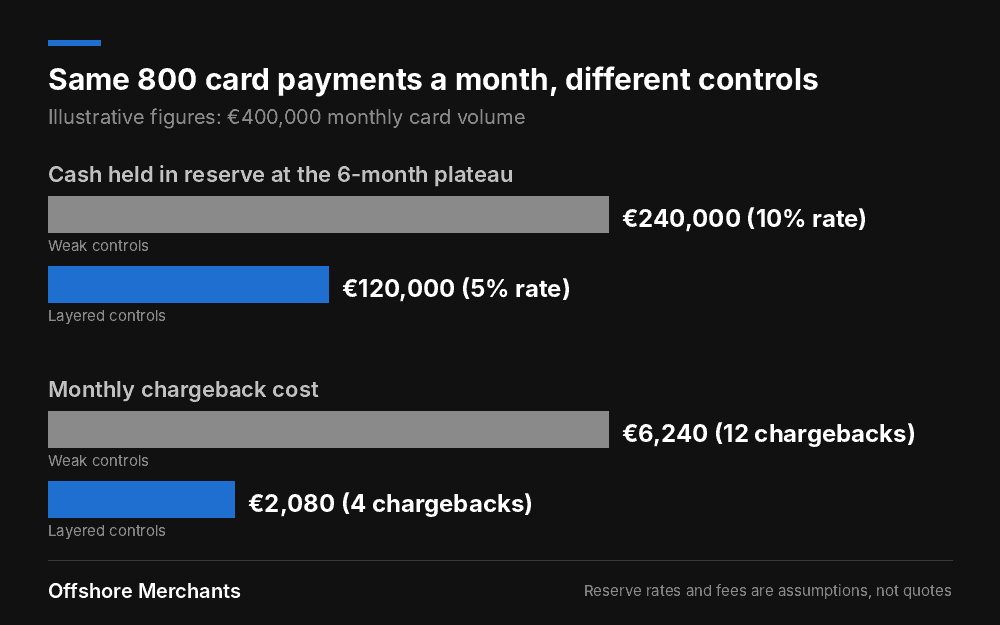
The saving is €4,160 a month in chargeback costs, and €120,000 less tied up in reserve. A processor is not obliged to lower a reserve because your fraud rate improves, and the rate it offers depends on your history and its own policy. For the mechanics of how reserves build and release, see our guide to rolling reserves on high-risk merchant accounts.
How should an FX provider present its business to a processor?
Describe the business accurately and lead with evidence of control. Processors penalise mismatches between what you say you do and what your transactions show far more heavily than they penalise a clearly explained high-risk model.
A strong application usually covers these points:
- Your licence or registration, and the regulator that supervises you.
- How customer funds are safeguarded and reconciled.
- Your onboarding and sanctions screening process.
- Your outgoing-payment controls and review thresholds.
- Honest processing history, including refunds and chargebacks, with your plan to reduce them.
- Expected monthly volume, average ticket and the countries you serve.
Approval is never certain, and terms vary by business, history and region. If you want a view on which routes might suit your model, our overview of EU and US merchant accounts and our 10 questions to ask before choosing a payment provider are useful starting points.
Frequently asked questions
Can an FX provider get a merchant account before it is fully authorised?
Some processors will only talk to firms that already hold their licence or registration. Others may consider a pending application, usually with tighter terms and lower limits. Either way, be upfront about your status rather than leaving it vague.
Does a UK FX provider need separate arrangements for EU customers?
Generally the UK and EU/EEA regimes are separate, and a UK authorisation does not automatically allow you to serve customers in every EU country. Take legal advice on each market, and tell your processor which countries you serve.
Do bank transfers avoid the fraud problem?
They avoid card chargebacks but carry their own risks, such as payment recalls and authorised push payment fraud. UK and EU rules on reimbursement and payee checks have been tightening, so check the current position with your regulator.
What happens to funds when a chargeback arrives after a payout?
The processor usually recovers the disputed amount from you, through your settlement balance, your reserve or a direct debit of your account. That is why outgoing-payment controls matter as much as incoming ones.
Where should you start?
Start with the outgoing payment, the layer most providers skip, then tighten onboarding and keep clean evidence for disputes. Better controls make processors more comfortable, though they cannot guarantee any outcome.
If you are an FX or payments provider in the UK or EU/EEA and want to explore high-risk merchant account options that fit your business model, contact our team at Offshore Merchants for a no-obligation conversation. This article is general information, not legal or regulatory advice.